
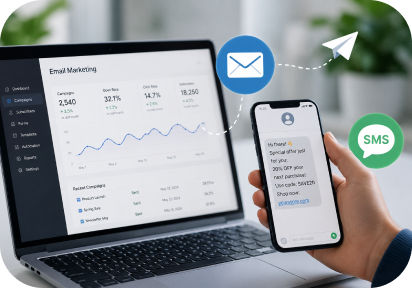
Quick Answer: One-time customers limit business growth because businesses invest time and money to acquire them but receive only a single purchase in return. Improving customer retention through email marketing, SMS marketing, and loyalty programs increases customer lifetime value, reduces acquisition costs, and creates more predictable revenue.
Most business owners are focused on getting more customers.
It’s understandable. New customers bring new revenue, new opportunities, and the feeling that the business is growing. Marketing campaigns, social media content, advertising, partnerships, and promotions are often built around one objective: attracting more people to buy.
But there’s a question that doesn’t get asked often enough:
What happens after the first purchase?
For many businesses, the relationship ends there.
The customer buys once, receives their product or service, and disappears. Months later, the business is still spending money to acquire new customers while hundreds—or even thousands—of previous buyers remain inactive.
At first glance, this might not seem like a problem. After all, a sale is a sale.
But when you look closer, one-time customers can become one of the most expensive growth challenges a business faces.
Why One-Time Customers Cost More Than You Think
Every customer acquisition comes with a cost.
Sometimes it’s obvious, like a paid advertisement. Other times it’s hidden in content creation, website optimization, sales calls, promotional discounts, or the time spent managing marketing campaigns.
Most businesses calculate the revenue generated from a sale but overlook how much effort was required to generate that sale in the first place.
Imagine you spend $30 to acquire a customer who places an $80 order. After accounting for product costs, transaction fees, fulfillment expenses, and support time, your profit may be relatively small.
Now imagine that customer never buys again.
Suddenly, the economics look very different.
The acquisition cost remains the same, but the customer lifetime value remains low. Instead of building a long-term revenue stream, you’ve earned a single transaction and must start the acquisition process all over again.
This cycle repeats itself in businesses across nearly every industry.
The Difference Between Revenue and Lifetime Value
One of the biggest mistakes growing businesses make is focusing exclusively on immediate revenue.
Revenue tells you what happened today.
Customer lifetime value tells you what happens over the entire relationship.
A customer who spends $100 once has a lifetime value of $100.
A customer who spends $100 four times over the next two years has a lifetime value of $400.
Both customers looked identical during their first purchase.
The difference only became visible over time.
This is why successful businesses often measure customer retention as carefully as they measure customer acquisition. They understand that long-term growth depends not only on attracting new customers but also on increasing the value of existing relationships.
Most Customers Don’t Leave Because They’re Unhappy
Many business owners assume that customers disappear because something went wrong.
The product wasn’t good enough.
The service wasn’t fast enough.
A competitor offered a better deal.
While those situations certainly happen, they’re often not the primary reason customers fail to return.
More commonly, customers simply forget.
People are overwhelmed with choices. They receive countless emails, see thousands of advertisements, scroll through endless social media feeds, and interact with dozens of brands every week.
Even when they have a positive experience, many businesses gradually fade from memory.
Think about your own purchasing behavior.
You’ve probably ordered from a company, enjoyed the experience, and still never returned. Not because you disliked them, but because life got busy and the brand stopped appearing in your world.
This is one of the most overlooked realities of customer retention.
Customers don’t always leave because they’re dissatisfied.
Many leave because the relationship was never maintained.
Why Retention Creates More Predictable Growth
Businesses that rely exclusively on customer acquisition often find themselves trapped in a cycle.
Every month starts with the same challenge.
Generate more traffic.
Create more content.
Launch more ads.
Find more leads.
Acquire more customers.
While acquisition is essential, it becomes increasingly expensive when there is no retention strategy supporting it.
Customer retention changes the equation.
Instead of generating revenue solely from new customers, businesses begin generating additional revenue from people who already know, trust, and have purchased from them before.
This creates a more predictable business model because growth is no longer dependent on constantly finding new buyers.
The Brands People Remember Usually Win
Consumers rarely buy from every brand they encounter.
Most of the time, they buy from the brands they remember.
This is why visibility matters long after the first sale.
A customer may not need your product today, next week, or even next month. But when the need eventually returns, familiarity often influences the decision.
Brands that remain present through valuable communication have a significant advantage.
This doesn’t mean sending endless promotions.
It means maintaining relevance.
Educational emails, helpful resources, customer-exclusive offers, product tips, loyalty rewards, and personalized communication all help strengthen the relationship.
The objective isn’t simply to sell again.
The objective is to remain memorable.
The Role of Email Marketing, SMS Marketing, and Loyalty Programs
Customer retention doesn’t happen automatically.
It requires intentional communication.
Email marketing allows businesses to stay connected through educational content, updates, recommendations, and promotions.
SMS marketing provides timely communication that reaches customers quickly and directly.
Loyalty programs create incentives that reward customers for returning and continuing to engage with the brand.
When used strategically, these channels work together to increase customer lifetime value while reducing the pressure to constantly acquire new customers.
More importantly, they help businesses build relationships rather than merely process transactions.
The Hidden Opportunity Inside Your Existing Customer Base
Many businesses spend significant resources chasing their next customer while overlooking the customers they’ve already earned.
Yet existing customers often represent the easiest path to growth.
They already know your brand.
They’ve already trusted you enough to buy.
They’ve already overcome the uncertainty that prevents many prospects from making their first purchase.
In other words, the hardest part is already done.
The opportunity lies in creating meaningful reasons for them to return.
Key Takeaways
- One-time customers are often less profitable than they initially appear.
- Customer acquisition costs continue to rise across most industries.
- Customer lifetime value is a critical metric for sustainable growth.
- Many customers stop buying because they forget the brand, not because they are unhappy.
- Customer retention creates more predictable revenue than acquisition alone.
- Email marketing, SMS marketing, and loyalty programs help businesses stay visible and strengthen customer relationships.
- The businesses that grow most efficiently maximize the value of existing customers before constantly pursuing new ones.
The Real Cost Isn’t Losing the Sale—It’s Losing the Relationship
The most successful businesses understand something that many competitors overlook: the first purchase is not the goal.
It’s the beginning.
Every one-time customer represents future opportunities that may never materialize if the relationship ends after the first transaction. Additional purchases, referrals, loyalty, and long-term revenue all depend on what happens next.
Businesses that prioritize customer retention build stronger foundations because they generate more value from customers they have already worked hard to acquire.
If you’re ready to learn how modern brands use email marketing, SMS marketing, customer journeys, and loyalty programs to turn first-time buyers into long-term customers, explore our Email Marketing Academy.
Inside, you’ll learn practical strategies, proven frameworks, and real-world examples that help businesses increase customer lifetime value and build more predictable revenue.
Because the most profitable customer is rarely the next one.
It’s often the one you’ve already earned.
Frequently Asked Questions
Why are one-time customers expensive?
One-time customers are expensive because businesses invest resources to acquire them but only generate revenue from a single purchase. Without repeat purchases, customer acquisition costs remain high while customer lifetime value remains low.
What is customer retention?
Customer retention refers to a business’s ability to keep customers engaged and encourage repeat purchases over time. High customer retention often leads to greater profitability and stronger customer relationships.
What is customer lifetime value?
Customer lifetime value (CLV) measures the total revenue a customer generates throughout their relationship with a business. Increasing CLV is one of the most effective ways to improve long-term profitability.
Why do customers stop buying?
Customers may stop buying because their needs change, competitors capture their attention, or they simply forget about the brand. Lack of ongoing communication is one of the most common reasons customers fail to return.
How can businesses improve customer retention?
Businesses can improve customer retention by maintaining regular communication, delivering value after the purchase, personalizing customer experiences, and implementing loyalty programs that reward repeat engagement.
How do email marketing and SMS marketing help retain customers?
Email marketing and SMS marketing help businesses stay visible, share relevant content, promote offers, and nurture customer relationships. Consistent communication helps prevent customers from forgetting the brand.